Skip to Navigation Skip to Content

Restoring a Georgian farmhouse

Click on gallery images to view larger picture.

Pamela and Jason Crawley and their son James have worked together to restore a Georgian farmhouse. A passion for authenticity ensured this project won Best Country House in our Readers’ Awards 2011.

Pamela Crawley and her husband JasonFact file

Location: Norfolk
Period: Farmhouse built in 1790 and extended in 2010
Size: Five bedrooms
Owners: Pamela Crawley and her husband Jason, a chartered building surveyor; they have three grown-up children: Catherine, Sophie and James, an interior designer.

After renting in Norfolk for five years while waiting for the right renovation project to come along, Pamela and Jason Crawley finally found this Georgian farmhouse a few miles from Norwich in 2009. Enlisting the help of their son James, who is equally passionate about historic architecture, the family has completely restored what was a dilapidated house into one with period style and splendour. Their extensive research and attention to detail is clear throughout the property, making this the judges’ top choice for Best Country House in the Readers’ Awards 2011.

‘We waited a long time for the ideal house in a peaceful location,’ says Pamela, ‘and when this one came up for auction two years ago, it suited us perfectly. It required a huge amount of restoration, had potential for an extension, and is set in beautiful rolling countryside on the outskirts of a pretty village. The timing was just right, too: our youngest son James had just completed a degree in architectural studies, so he was able to work with us full time for the year we planned to complete the renovation.’

The house had a sound structure but had been unsympathetically modified in the 1950s and 1960s: there were metal windows everywhere, patterned carpets, ceramic tiled fire surrounds, no central heating or mains water, and cement render had been applied outside. ‘No maintenance had been done for 50 or so years,’ adds Jason, ‘so the flooring was in a poor state in many rooms, both upstairs and down; and the original features had been either removed or covered up.’

The family worked together as a team: Jason, a chartered building surveyor, headed the restoration as architect and project manager, while James aided him with the architectural design, also taking the lead as interior designer; Pamela, meanwhile, assisted and advised on all levels of the work and choosing materials. ‘After several months of planning,’ she says, ‘we came up with a design that included turning the house around, gutting what was already there, and doubling the property in size.’

‘We wanted to ensure that the renovation was completed as authentically as possible,’ says Jason, ‘so it was imperative to save or replace all the features that had been damaged or lost. To recreate the missing details, such as the timber framed windows and shutters, James spent innumerable hours researching Georgian properties, and took a lot of inspiration from other farmhouses in the area. He was then able to work closely with the tradespeople and specialists to ensure every new element was historically accurate.’ The family also spent a lot of time at salvage yards collecting bricks, floorboards, flagstones and timber beams – that had just the right amount of wear and patina – to repair the structural components damaged over time.

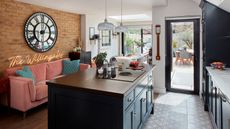
The restoration was important, but the extension was an equally essential part of this transformation. It would give the house a large farmhouse kitchen, a formal dining room, a spacious entrance hall in the centre from which all the principal rooms are now accessed, and a master suite above. The latter comprises three interlinking rooms: the bedroom, a dressing room and a bathroom in between; by designing it this way, the dressing room can become an extra bedroom if required in the future.

To ensure that these new rooms blend seamlessly with the original structure, the same meticulous attention to detail and use of old materials have been applied. ‘Nine inch walls were built internally to match the existing ones,’ says Jason, ‘and any new plasterwork was given soft curves. We also sourced more reclaimed flooring: Norfolk pamments for the kitchen, Portland stone to be laid in the entrance, and reclaimed floorboards for the dining room and master bathroom. The other rooms we carpeted in sisal for a warmer feel.’

‘All the doors are 19th century,’ adds James, ‘and therefore all slightly different. And to finish them off, we added antique brass door knobs, which are in keeping with the Georgian farmhouse feel.’

The smart country house style has been continued in the decoration, too, which further unifies the two halves. James chose a complementary palette of Farrow & Ball shades that range from light and airy off whites – such as White Tie in the kitchen – to those with a little more depth, for instance Light Blue in his own room, and Bone in the dressing room. ‘We felt it was important to have different colours in each room, but that each should work together,’ says Pamela, who also had a specific brief for her son when it came to the soft furnishings. ‘I’ve always liked timeless designs and classic fabrics from companies such as Colefax & Fowler, Zoffany, and Jane Churchill work beautifully with the various antique and traditional pieces of furniture we brought from our previous house.’

The farmhouse has been complete for almost a year now, and Pamela and Jason are finally settling into their new home; thankfully, the dream they’d had for so many years has definitely lived up to their expectations. ‘Ultimately, we feel our home reflects the time, effort and passion that has been integral in every stage of this renovation project,’ says Pamela. ‘Many people might have torn down an old building and just started from scratch, but for us that was never an option as we have the greatest sympathy for historic architecture. That visitors are often amazed that any part of this house is new is possibly the greatest compliment we could ever receive.'


Pamela with her husband Jason and son JamesThe secret of their renovation success

Pamela says: ‘We carefully planned every detail: the architectural design, the colour schemes, even where furniture was going to be placed. This proved essential when deciding where to put electric sockets and light switches.’

Salvaged items were just as meticulously thought through. James says: ‘We spent a day at one reclamation yard just laying out the bricks to repair the two fireplaces we’d uncovered. I didn’t want them to be too uniformly perfect: they had to vary and look like they fitted with the originals. One of our favourite places was Morways Reclamation & Architectural Salvage (01953 483914; morways.co.uk).’


Get the Georgian farmhouse look
Find out more about the Period Living Readers' Awards...

FEATURE NAOMI JONES PHOTOGRAPHS BRIDGET PEIRSON
Featured in the November 2011 issue of Period Living

Useful links: 
CP Hart Group
Designer bathrooms
Colefax & Fowler
Fabric and wallpaper
Country & Eastern
Traditional and antique furniture and home accessories
Farrow & Ball
Hand crafted wallpapers and paint
Feather and Black
Beds and bedroom furniture
Morways
Reclamation and architectural salvage yard
The Alternative Flooring Company
Natural carpets and flooring

Comments

Post new comment

The content of this field is kept private and will not be shown publicly.
CAPTCHA
This question is to prevent computer generated spam submissions. Please enter the code exactly as you see it, with no spaces between characters, and with upper and lower case letters as displayed
Image CAPTCHA
Enter the characters shown in the image.